




Spring Cleaning, the Fleet Way
Spring officially started Friday, March 20, and while some fleets may still be waiting for all the snow to melt, now is the time to shift from winter survival to summer readiness.
 MENU
MENU SEARCH
Spring officially started Friday, March 20, and while some fleets may still be waiting for all the snow to melt, now is the time to shift from winter survival to summer readiness.
*Summarized by AI
Spring officially started Friday, March 20, and while some fleets may still be waiting for all the snow to melt, now is the time to shift from winter survival to summer readiness.
But what does that look like for your fleet?
It could potentially look like pulling last season apart while you still have time to change the next one. Winter can leave behind wear, the kind both visible in the shop and the kind caused my mental fatigue.
However, this time of the year should be seen as a positive to those frustrations by allowing for a chance to decide what needs the most attention while refreshing any any operational plans for the year ahead.
Readiness can also look like using last year as a guide. The goal is to have a detailed look at what caused the biggest problems last year, especially around downtime, disruption, and risk, then using that to set priorities.
Spring is the time of year when patterns are easier to see. This is a useful point in the year to look at performance trends and make adjustments, whether the shop is calm or still in catch-up mode.
Use last year as your reference point, then zero in on where things went off track, focusing on the points that caused downtime and disruption, such as units that repeatedly went out of service or PM schedules that drifted until they no longer controlled failures.
For fleet management, the value may lie in separating seasonal damage from recurring operational issues. Winter wear happens but the bigger problem is when the same failures and delays show up every year, even after the winter weather is gone.
That is usually tied to something you can change, whether it’s how inspections are performed and documented or how much repair history is captured in a way you can act on later.
Not sure where to start? Use a Leading Fleets application as a jumping off point. Leading Fleets applications have closed for 2026 but you can still download a sample application here. Answer the questions to gauge how your fleet has been doing and where you could see improvements.
Here’s where filling out an application can help:
Emergencies can happen at any time, and spring leaves little room between severe winter weather and warm-weather disasters such as hurricanes and fires. Even if your region does not see hurricanes or wildfires, most agencies face some combination of severe storms, flooding, heat events, and power disruptions.
The common fleet problem is not the hazard type; rather, it’s the speed at which the operation has to be ready.
Due to each fleet’s uniqueness, emergency readiness planning can fail when it stays generic. Spring is when you can make it specific to your team and response expectations.
What's the best jumping point? It might be simply figuring out what being prepared means for your operation. That means understanding which assets are priority response units, which are support units, and which can be temporarily reassigned without breaking core services.
That sounds obvious, but many fleets find that the list exists informally and depends on who is working that day. Locking it down now reduces confusion later.
Next, get your checklist up to date and nail down the details:
Spring is also the time to decide how you will track damage and cost during an event. If your fleet has ever needed reimbursement or documentation after an emergency, you already know why this matters.
A simple, consistent process for documenting unit assignment, damage photos, repair authorization, and parts usage is easier to build now than during response work.
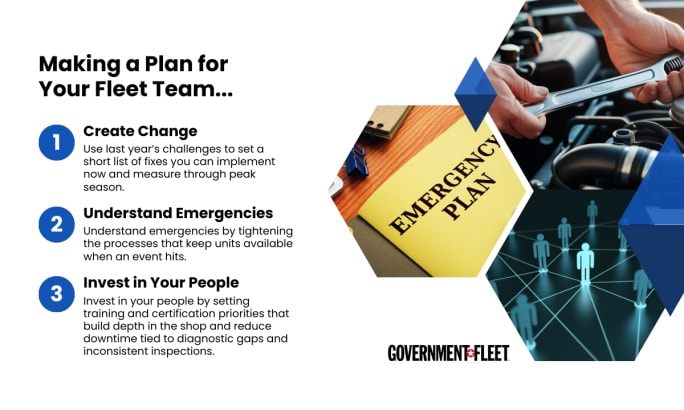
Operational change doesn't always start with a big plan, sometimes it starts with one recurring problem you finally decide you’re done living with.
Government Fleet
Is there particular training you’ve been planning to have your technicians take? Maybe this is the year you plan to get your CAFM certification.
If there are people-centered projects you’ve been thinking about, this is the time to start finalizing the plan, getting dates on the calendar, and making sure coverage is in place before summer demand ramps up.
Training is doable, but it requires deliberate scheduling so the shop doesn’t lose critical coverage. A good place to start is by focusing on what will affect uptime and safety in the next few months, not what looks good on a wish list.
Certifications can help build consistency across the shop, develop future leads, and strengthen the case for training budgets. Spring is a good time to map who is pursuing what and set realistic timelines.
Is it time to pursue one of the following?
If you have not been active in an association lately, spring is a good time to re-engage. The value is access to peers and operations who are either facing similar challenges or who have been through something similar. Sometimes it's as simple as having someone on the other end of the line to say that it's going to be okay.
For many fleets, the biggest value is not always the conference (though they are a great place to connect with peers). It’s the access to real-world answers when you’re trying to solve problems that may not have clear solutions.
Just like airing out a house and doing a deep clean, how that clean gets done is going to look different depending on how much needs attention. For fleets it’s the same.
Maybe most things have been taken care of, or maybe it’s time for a bigger overhaul. Either way, this is the window to decide what matters most and get the operation ready for the season ahead.
Loading data...
Spring officially started Friday, March 20, and while some fleets may still be waiting for all the snow to melt, now is the time to shift from winter survival to summer readiness.

Operations
Every fleet operation has a team that works in its own unique way. What matters is that each person understands how their role fits into the bigger workflow, and how the team functions as one.

Operations
When it comes to the public sector, outcomes are usually driven by three areas fleet leaders can actually control, but it’s combining these into one operating model where operations see the most success.

Operations
A look back at some key leadership points from the year and how that advice can shape the decisions for your fleet's future.